What Causes Breast Implant Rippling and How Can It Be Fixed?

You press near the edge of your breast and feel a crease. Maybe you notice a wrinkle across your upper pole when you lean forward, or a faint line through your swimsuit. That’s breast implant rippling, and it’s one of the most common reasons women come to our Beverly Hills pract
You press near the edge of your breast and feel a crease.
Maybe you notice a wrinkle across your upper pole when you lean forward, or a faint line through your swimsuit. That’s breast implant rippling, and it’s one of the most common reasons women come to our Beverly Hills practice for revision.
The good news: it doesn’t mean your implant is failing. It usually reflects a mismatch between implant and soft-tissue coverage.
Implant rippling correction is achievable, and Dr. Cassileth has spent over two decades helping patients fix it.
Key Takeaways
- Breast implant rippling is visible or palpable wrinkles that show through the skin, affecting up to 10% of augmentation patients.
- The main breast implant rippling causes are thin tissue coverage, saline fill, above-the-muscle placement, and oversized implants.
- Knowing how to fix breast implant rippling depends on the cause: switching to silicone, repositioning under the muscle, fat grafting, or acellular dermal matrix reinforcement.
- Most implant rippling correction procedures are outpatient, with 2 to 4 weeks of recovery and final results at 3 to 6 months.
- A board-certified revision specialist is essential for lasting breast implant rippling treatment.
What Is Breast Implant Rippling?
Breast implant rippling appears as wrinkles, folds, or creases on the implant’s surface that become visible or palpable through the skin.
Typically, you’ll notice it along the outer sides of the breast, the lower pole near the inframammary fold, or across the upper pole when you bend forward. Some women only feel it when they run a hand across the area, while others see it clearly in the mirror.
According to a peer-reviewed study, the incidence of rippling ranges from 0 to 35%, with higher rates in reconstruction cases where tissue has been thinned by previous surgery.
Here’s one distinction that matters: not all breast implant wrinkles are the same. A small amount of palpable rippling that only shows when you pinch the tissue is different from visible implant edges you can see in clothing.
Your correction plan depends on which category your case falls into, which is shaped in part by the details of your original breast augmentation.
What Causes Breast Implant Rippling?
Since correction planning depends on what’s driving your rippling, understanding the causes is where any fix starts.
Breast implant rippling causes are rarely one-dimensional. In most cases, you’re dealing with two or three overlapping factors, which is why correction has to be individualized to your anatomy.
If you’re exploring implant replacement, it’s worth knowing that new implants alone usually won’t solve rippling. The underlying tissue and placement have to be addressed too.
1. Thin Breast Tissue and Low Body Fat
The biggest reason rippling shows up is simple. There isn’t enough soft tissue between the implant and your skin. When your natural breast tissue and body fat are minimal, the implant’s contours can more easily telegraphed.
So if you’re lean, athletic, or have naturally small breasts with a low-normal BMI, you’re at higher risk. The thinner your coverage, the more visible the ripples become.
2. Implant Placement (Above vs. Below the Muscle)
Where your implant sits matters more than most people realize. The two main placement options have very different coverage:
- Subglandular (above the muscle) rests the implant above the pectoralis. Only your skin and breast tissue cover it.
- Submuscular (below the muscle) tucks the upper half under the pectoralis, adding a real layer of coverage.
That’s why rippling after breast augmentation is more common with above-the-muscle placement, especially along the upper pole, where the muscle would otherwise hide the implant’s edges.
3. Implant Type: Saline vs. Silicone
Saline is a liquid, so it moves freely inside the shell and can create visible folds when it settles. Silicone gel holds its shape better because it’s cohesive.
In fact, research published in Aesthet Surg J Open Forum shows the most cohesive silicone (“gummy bear”) implants have the lowest rippling rates of any device on the market. So if you’re prone to rippling from thin tissue, your implant material matters as much as placement.
4. Implant Fill Level
For saline implants, the fill level matters more than most patients realize. Here’s how it plays out:
- Underfilled implants collapse slightly inside the shell and wrinkle, which is a classic cause of rippling.
- Overfilled implants mask rippling but create firmness, unnatural shape, and a higher rupture risk.
- Properly filled implants sit at the middle or upper end of the manufacturer’s recommended range.
So when a surgeon fills toward the upper end, they’re deliberately trading a slightly firmer feel for long-term ripple resistance. That’s the balance most experienced surgeons aim for.
5. Implant Size Relative to Body Frame
Oversized implants stretch your skin and underlying tissue beyond comfortable capacity, which thins your natural coverage over time. If an implant exceeds the width of your natural breast footprint, the edges are more likely to show laterally.
This is one of the most preventable causes of visible implant edges.
It usually shows up when someone chooses a size larger than their anatomy could comfortably support, either because they wanted a dramatic result or didn’t fully understand the tradeoff between size and long-term coverage.
The footprint part matters. Your natural breast has a width, height, and projection baseline that your chest wall was built for. When an implant stretches beyond those dimensions, the surrounding tissue thins to accommodate it, and that thinning is exactly what lets rippling show through.
6. Weight Loss and Aging
Rippling can develop years after a successful augmentation, even when the implant itself hasn’t changed. Two common triggers cause that delayed onset:
- Significant weight loss reduces the natural tissue padding over your implant, whether from diet, exercise, GLP-1 medications like Ozempic or Wegovy, or a medical reason.
- Aging gradually thins your skin and dermal layers, so the same implant that used to sit under healthy coverage is now beneath a thinner envelope.
In both cases, the implant hasn’t moved or failed. Your tissue envelope has changed around it, and that change alone is often enough to let edges start showing.
7. Capsular Changes
Every implant forms a thin scar-tissue capsule around it as your body heals. Normally, the capsule stays soft and flexible, and you won’t feel it at all. But over time, a few things can shift:
- Thinning capsules lose their cushioning effect in certain areas, especially where tissue coverage was already minimal.
- Contracted capsules (capsular contracture) tighten and harden, which can push your implant into an unnatural position where edges become more prominent.
- Asymmetric changes, where one side thins while another contracts, can make rippling show up on only one breast.
So when a thinning capsule combines with thin skin, implant edges become much more visible. That’s why capsule-related rippling often requires more than just implant replacement to correct.
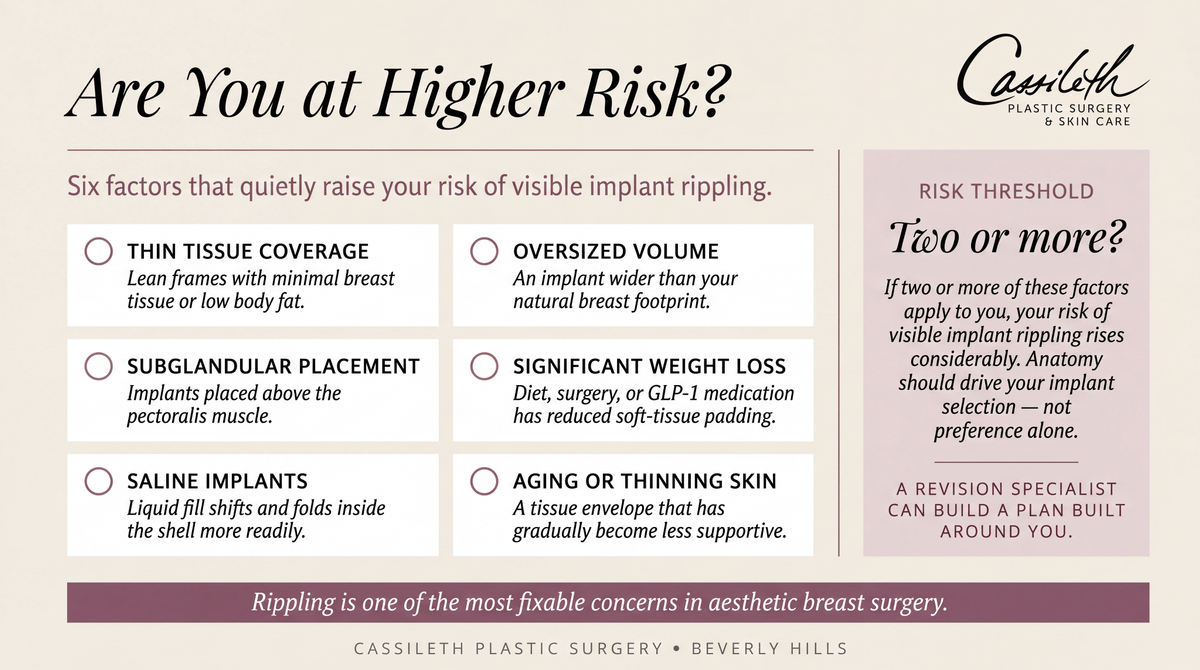
Who Is Most at Risk for Breast Implant Rippling?
Some patients are more predictably vulnerable to rippling after breast augmentation.
Knowing where you fall on the risk spectrum helps you plan better, whether that’s before surgery or as you consider next steps. If you’re already weighing explant surgery because of rippling, your risk profile also shapes which replacement option makes sense.
- Thin women with minimal breast tissue and low body fat.
- Subglandular saline implant recipients.
- Patients whose implant size exceeded their natural breast footprint.
- Those who lost significant weight after augmentation.
- Reconstruction patients with limited skin and tissue coverage.
- Older patients whose skin has thinned with age.
If you check two or more of those boxes, your odds of breast implant wrinkles rise considerably.
That doesn’t mean augmentation is off the table. It just means placement and implant selection have to be planned around your risk profile from the start.
How to Fix Breast Implant Rippling

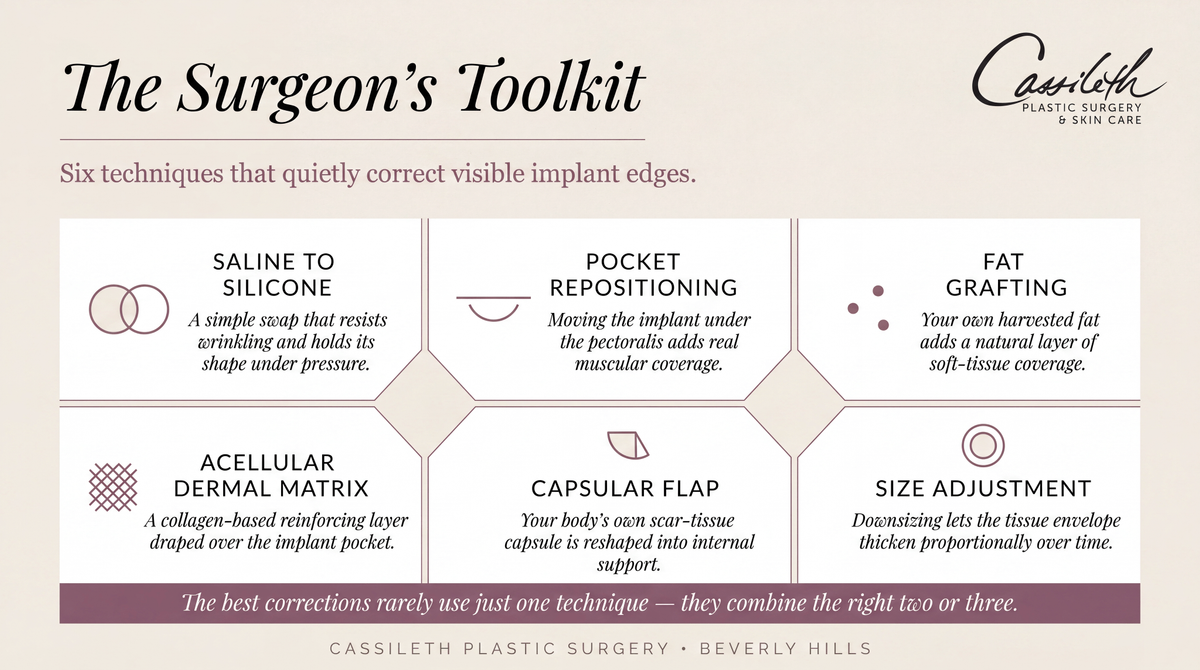
Now that you know what’s causing your rippling, the fix becomes more straightforward. Knowing how to fix breast implant rippling depends on the cause, so there isn’t one procedure that works for everyone.
Instead, the best revision plans combine two or more techniques tailored to your anatomy, your current implants, and your goals. Here are the core tools your surgeon will consider.
Switching from Saline to Silicone Implants
If saline fill is driving your rippling, switching to silicone gel is often the single most effective fix.
Silicone holds its shape, resists wrinkling, and works especially well for thin patients. Highly cohesive “form-stable” devices hold their contour even under pressure, which is why they’re the go-to option if you have a history of visible rippling.
Changing Implant Placement
If your implants sit above the muscle, moving them into a submuscular or dual-plane position adds an entire layer of pectoralis coverage over the top.
That upper pole shift matters because the muscle hides the implant edge that would otherwise telegraph through. Repositioning is a more involved revision than a simple implant swap, but for thin-tissue patients, it usually delivers the biggest visible improvement.
Fat Grafting Over the Implant
Autologous fat grafting adds a natural layer of tissue directly over your implant.
Fat is harvested from your abdomen or thighs, then injected in thin layers over the upper and outer poles where rippling typically shows.
According to Plast Reconstr Surg Glob Open, this hybrid approach (called composite augmentation) effectively conceals implant edges and improves contour in thin patients. That’s why fat grafting has become one of the most versatile tools for breast implant rippling treatment, especially when your natural coverage is too thin to hide the implant on its own.
Acellular Dermal Matrix (ADM) or Surgical Mesh
If your native tissue coverage is simply too thin, products like AlloDerm or Strattice add a collagen-based reinforcing layer draped over your implant during revision.
This extra coverage camouflages rippling and supports the implant pocket.
ADM is especially useful in reconstruction cases and complex revisions where your own tissue isn’t enough.
In a meta-analysis published in Aesthetic Surgery Journal, Strattice reduced capsular contracture risk compared with standard treatment, making it one of the more reliable tools for breast implant rippling treatment when coverage reinforcement is the goal.
Capsular Flap Techniques
In some cases, your own capsular tissue can become the solution.
Remember, every implant develops a thin scar-tissue capsule around it during healing. When that capsule is thick enough and healthy enough, your surgeon can reshape it into a flap and reposition it over the thin areas where your implant edge shows through.
This approach has a real advantage: it uses tissue your body already made, so there’s no external material to source or pay for. It’s especially practical when your capsule quality is adequate and you want to avoid the cost of ADM or the donor-site recovery that comes with fat grafting.
Implant Size Adjustment
Sometimes the simplest fix is also the most effective.
If your current implant is oversized for your frame, it will keep stretching your tissue past its natural capacity and showing edges, no matter which reinforcement material you use on top of it.
Downsizing to a volume your tissue can comfortably cover solves the problem at its root.
Your skin tension decreases, your tissue envelope thickens proportionally, and your ripple risk drops significantly going forward. This is often the right call if oversizing was the original cause, and it pairs well with any of the other techniques your surgeon might recommend.
Breast Implant Rippling Correction: What to Expect
Now that you’ve seen the full toolkit, here’s what your revision actually looks like.
Most implant rippling correction procedures are outpatient surgery under general anesthesia. Operative time runs from 90 minutes for a simple implant exchange to 3 or 4 hours when your surgeon combines fat grafting, pocket repositioning, and ADM placement.
Recovery tracks your primary augmentation in broad strokes.
You’ll rest at home for 3 to 5 days, return to light activity at 2 weeks, and resume full exercise at 4 to 6 weeks. Most revision patients find recovery more comfortable than their first surgery because the tissue pocket is already established, so the surgical footprint is smaller.
Can Breast Implant Rippling Be Prevented?
Most rippling is preventable, and prevention starts at your very first consultation. If you have thin tissue, your surgeon should typically recommend:
- Silicone gel over saline.
- Submuscular or dual-plane placement over subglandular.
- An implant sized to your natural breast footprint, not one that stretches it.
Anatomy drives these choices more than preference. Ordering the largest implant available without matching it to your tissue envelope is one of the most common paths to long-term breast implant wrinkles, and it’s preventable with honest sizing conversations upfront.
Long-term prevention matters too. Your daily habits protect your results:
- Maintain a stable weight, since fluctuations thin your tissue coverage
- Avoid nicotine, which reduces blood flow and skin elasticity
- Protect your skin health with sunscreen and quality skincare
- Schedule periodic exams with your surgeon to catch changes early
If you’re planning a major weight loss journey or pregnancy, wait until those changes stabilize before making final implant decisions. Otherwise, you’re building on a foundation that will keep shifting.
Why Choosing the Right Surgeon Matters
Rippling correction isn’t a beginner procedure. It takes revision experience to diagnose the true cause, technical range to combine multiple techniques in one operation, and aesthetic judgment to preserve shape while reinforcing coverage.
So when you’re interviewing providers, look for a board-certified plastic surgeon with documented revision experience. The American Society of Plastic Surgeons recommends at minimum ABPS certification, at least six years of surgical training, and practice in accredited facilities.
Dr. Cassileth has spent decades refining breast revision protocols that address the full spectrum of rippling presentations, from simple implant exchange to complex multi-technique correction.
Ready to Stop Living With Rippling?

The fact that you can see or feel rippling doesn’t mean you’re stuck with it. Breast implant rippling is one of the most fixable concerns in aesthetic breast surgery once you work with a surgeon who diagnoses it properly and combines the right techniques.
So if you’re dealing with visible implant edges or persistent wrinkles, the next step is a detailed exam. Schedule a consultation with Dr. Cassileth in Beverly Hills to map out a correction plan built for your anatomy.
FAQs
What causes breast implant rippling?
Breast implant rippling causes are usually a mix of thin tissue coverage, saline fill, above-the-muscle placement, oversized implants, weight loss, or capsular changes. Most patients have two or more factors contributing at once, which is why correction addresses the root cause, not just the implant.
Can breast implant rippling be fixed without surgery?
Usually no. There are no reliable non-surgical treatments for breast implant rippling once visible implant edges show through the skin. Creams, lasers, and fillers can’t add soft-tissue coverage. If rippling is noticeable, surgical correction like implant exchange, fat grafting, or ADM placement is the effective path.
Is breast implant rippling more common with saline or silicone?
Saline ripples more often than silicone because liquid fill shifts inside the shell and creates folds. Silicone gel holds its shape, and highly cohesive “gummy bear” implants have the lowest rippling rates of any device available. For thin patients, silicone is almost always the better option.
Does implant placement affect rippling?
Yes. Subglandular placement above the muscle relies only on skin and breast tissue for coverage, so rippling after breast augmentation shows more readily. Submuscular or dual-plane placement adds pectoralis coverage, especially along the upper pole, making it a common fix during implant rippling correction.
How long does recovery take after rippling correction surgery?
Breast implant rippling treatment recovery mirrors a primary augmentation. Expect 3 to 5 days of rest, light activity at 2 weeks, and full exercise at 4 to 6 weeks. Final shape settles around 3 to 6 months. Most patients find revision recovery more manageable than their original surgery.
More from the journal


