

The idea that breast implants must come out every ten years is one of the most persistent myths in aesthetic surgery, and it sends thousands of women into revision consultations they may not actually need. So how long do breast implants last in real life? Modern implants were ne
The idea that breast implants must come out every ten years is one of the most persistent myths in aesthetic surgery, and it sends thousands of women into revision consultations they may not actually need.
So how long do breast implants last in real life?
Modern implants were never built around a fixed timeline. Breast implant lifespan depends on the device, your anatomy, surgical technique, and whether complications ever develop.
In Beverly Hills, Dr. Cassileth helps you separate cosmetic preference from genuine medical need.
Key Takeaways
- The ten-year rule is a myth rooted in old warranty terms, not biology or the FDA’s breast implant replacement timeline guidance.
- Most modern silicone and saline implants last 15 to 20 years or longer with proper placement and care.
- Silicone implant longevity depends on implant type, shell design, surgical placement, and your individual body chemistry.
- Silent silicone rupture can only be confirmed through MRI or high-resolution ultrasound, which is why breast implant rupture signs often go undetected without imaging.
- Routine monitoring, not automatic replacement, is the standard recommended by board-certified plastic surgeons.
Where Does the “10-Year Rule” Come From?
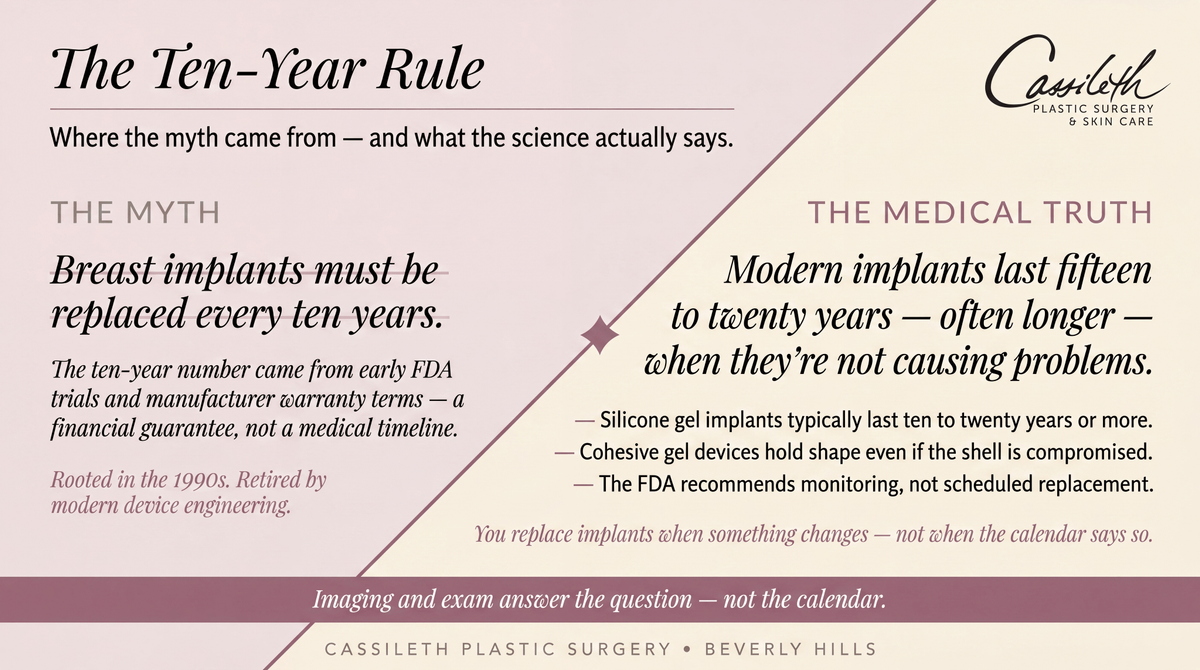
The ten-year number traces back to two things: early FDA safety trials and the manufacturer warranties from Mentor, Allergan, and Sientra.
Those warranties covered device failure for about a decade, which patients often read as an expiration date. In reality, a warranty is a financial guarantee, not a medical timeline.
Older implants added to the confusion. Thinner shells and liquid gel fill produced higher rupture rates in the 1990s and early 2000s, shaping much of today’s conservative guidance. Device engineering has since advanced, and modern cohesive gel and saline implants use multi-layer shells designed for much longer wear.
So do breast implants need to be replaced once the warranty expires? No. If your breast augmentation went smoothly and you have no symptoms, breast implant lifespan is measured by imaging and exam, not the calendar.
How Long Do Breast Implants Actually Last?
Here’s what the current evidence tells us:
- Most modern saline implants last about 10 to 15 years before rupture becomes a measurable risk.
- Silicone gel implants typically last 10 to 20 years, with many women keeping them well past the two-decade mark.
- Cohesive gel devices, sometimes called gummy bear implants, appear to have even greater durability because the filler holds its shape if the shell is damaged.
That’s backed by real data. A 10-year prospective study tracking 385 silicone gel implants across 205 patients reported only 7 ruptures and no cases of late seroma or ALCL, with an “excellent safety profile” overall.
Still, no implant is permanent. Silicone implant longevity varies with shell integrity, trauma, smoking, rapid weight changes, and surgical handling. So the honest answer to when to replace breast implants is usually “when something changes,” not on a fixed schedule.
Silicone vs. Saline: Does Implant Type Affect Longevity?
Yes, the implant material influences both lifespan and how rupture presents. Saline deflates visibly within days of shell failure, while silicone gel often ruptures silently, which is why imaging matters.
During a breast implant replacement consultation, the right choice comes down to your anatomy, tolerance for maintenance imaging, and aesthetic goals.
| Factor | Saline | Silicone Gel |
|---|---|---|
| Average lifespan | 10 to 15 years | 10 to 20+ years |
| Rupture detection | Visible deflation | MRI or high-resolution ultrasound |
| Feel | Firmer, more rippling in thin patients | Softer, more natural |
| Cost | Lower | Higher |
| Volume adjustment | Possible during surgery | Pre-filled, fixed |
Signs Your Breast Implants May Need to Be Replaced
Paying attention to your body matters more than watching the calendar. When it comes to breast implant rupture signs, these are the clinical indicators you should look out for. If any of them apply to you, a focused exam is the right next step.
For some patients, that may lead to an explant surgery consultation.
Capsular Contracture
Every implant forms a thin scar-tissue capsule around it, and in some women that capsule thickens and tightens, squeezing the implant.
You may notice increasing firmness, a rounded or high-riding shape, visible distortion, or aching pain. Capsular contracture is graded on the Baker scale, with grades III and IV usually warranting surgical correction.
Peer-reviewed research puts contracture rates between 5 and 19 percent for augmentation, with higher risk in subglandular placement and after radiation therapy.
It shortens breast implant lifespan and signals when to replace breast implants.
Implant Rupture
Breast implant rupture signs depend on the fill. Saline rupture shows obvious deflation, size change, and asymmetry within days. Silicone rupture, however, can stay silent for months or years.
According to the FDA, routine imaging is the reliable way to detect silent rupture. You may also notice a new lump, rippling, firmness, a pulling sensation, or shifted nipple position.
Changes in Shape, Size, or Position
Gravity, weight changes, pregnancy, and aging tissue all shift how your implants sit.
Visible rippling through thin upper-pole skin, an implant that has “bottomed out” below the fold, new asymmetry, or lateral drift usually mean the pocket has relaxed. These changes are more cosmetic than dangerous, but they’re one of the most common reasons patients start asking when to replace breast implants.
Pain or Discomfort
Persistent pain that started long after your initial recovery deserves attention.
New chest tightness, burning, or shooting discomfort along the implant edge can signal capsular issues, nerve irritation, or early rupture.
So if pain is your main concern, imaging should happen soon rather than at your next routine screening. It’s often one of the clearest breast implant rupture signs worth acting on.
Breast Implant Illness (BII) Symptoms
Some women report systemic symptoms they attribute to their implants, including fatigue, brain fog, joint pain, hair loss, and anxiety. BII is still being studied, and no single diagnostic test confirms it.
Still, a 2025 systematic review of 6,048 women documented symptom improvement in 81.9% of patients after explant surgery. These concerns factor heavily into when to replace breast implants, even when imaging looks normal and breast implant lifespan otherwise seems unchanged.
FDA Recommendations for Breast Implant Monitoring
The FDA’s guidance has replaced the old “replace everything at ten years” assumption.
For silicone gel implants, the FDA recommends an initial MRI or high-resolution ultrasound screening at five to six years after placement, followed by imaging every two to three years after that. Saline implants don’t require routine imaging, since rupture is visibly obvious.
The rationale is simple. According to FDA labeling for silicone implants, modern devices are durable enough that scheduled imaging catches problems earlier than scheduled surgery would.
Ultrasound has also become a first-line tool in many practices because it’s affordable, convenient, and still accurate.
So the model flips. You don’t replace implants on a schedule; you monitor them, which reshapes the breast implant replacement timeline and informs when to replace breast implants.
What Happens If You Don’t Replace Old Breast Implants?
If your implants are intact and symptom-free, the medically correct answer is to leave them alone.
Intact modern implants with no rupture, contracture, or tissue changes don’t require surgery. And since elective replacement still carries anesthesia, scarring, and infection risks, every exchange should have a clinical reason.
The calculus changes once something goes wrong. According to the FDA, silicone gel can migrate beyond the capsule after rupture, and removing it gets harder the longer it’s left.
So if you’ve had implants for 15 or 20 years with no issues, routine imaging answers when to replace breast implants. Symptomless long-term implants are doing their job, which is the most honest breast implant lifespan answer.
Breast Implant Lifespan Timeline: What to Expect Year by Year

So what does your breast implant lifespan actually look like on the ground?
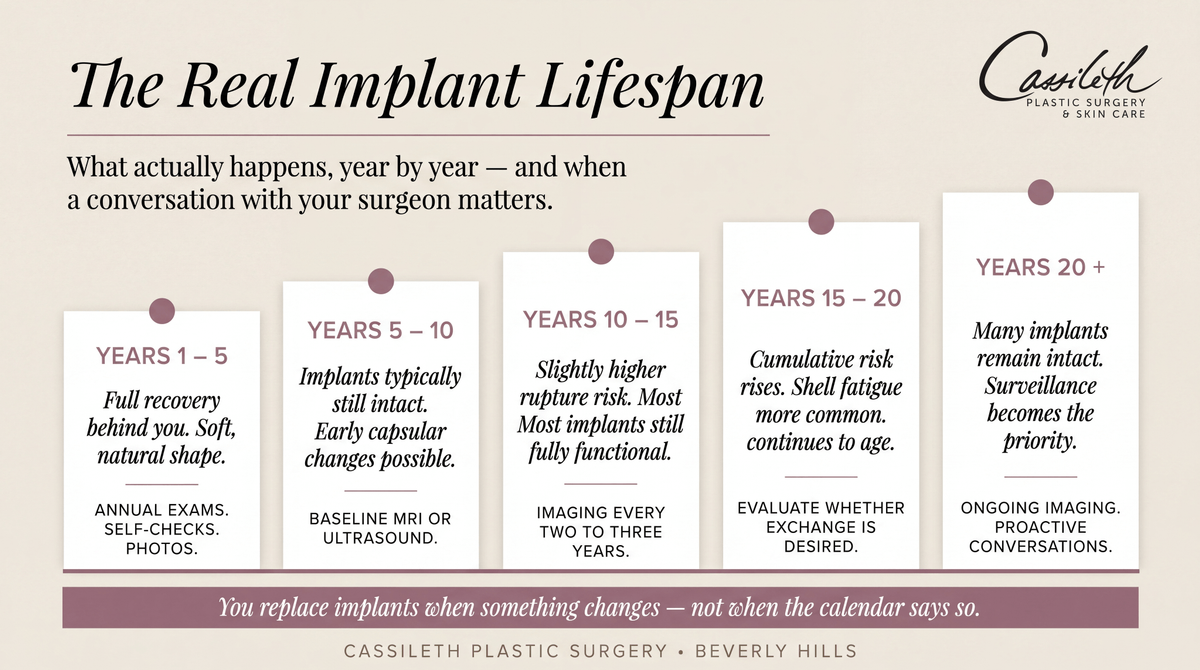
Use this timeline as a reference for what typically happens at each stage after placement. The breast implant replacement timeline below is a general guide, not a prescription, and your individual experience may vary.
| Timeframe | What to Expect | Recommended Action |
|---|---|---|
| Years 1 to 5 | Full recovery completed, soft natural feel, stable shape, very low complication rate | Annual breast exams, self-checks, photos for comparison |
| Years 5 to 10 | Possible early capsular changes, continued monitoring recommended, implants usually still intact | Baseline MRI or ultrasound at year 5 to 6 for silicone, annual clinical exam |
| Years 10 to 15 | Slightly increased rupture risk, tissue aging may change appearance, most implants still functional | Imaging every 2 to 3 years, consultation if symptoms appear |
| Years 15 to 20 | Higher cumulative risk of rupture or contracture, shell fatigue more common, cosmetic changes from aging | Continued imaging, evaluate whether exchange is desired or medically indicated |
| Years 20 plus | Many implants still intact, but surveillance becomes more important, revision becomes more common | Ongoing imaging, discuss options proactively with your surgeon |
So use this breast implant replacement timeline to set expectations. It’s not a countdown to surgery.
When Should You Talk to Your Surgeon About Replacement?
So how do you know when it’s time? Certain signals should prompt you to call your plastic surgeon rather than wait and see. Schedule an evaluation if you notice:
- A visible change in shape, position, or symmetry that wasn’t there before.
- Firmness, tightness, or aching that developed gradually.
- A lump, ripple, or deflation on one side.
- Chest pain, pulling, or a new sensation at the implant edge.
- Systemic symptoms you suspect are related to your implants.
- You’re approaching the 10 to 15 year mark and want a baseline image.
- You want to change size, profile, or switch from saline to silicone.
Knowing when to replace breast implants also includes lifestyle factors. Patients preparing for weight loss, pregnancy, or breastfeeding often plan an exchange around those milestones.
Others choose breast revision to refresh results after years of tissue change.
Why Choosing the Right Surgeon Matters for Implant Longevity
Technique shapes outcomes. Precise pocket dissection, no-touch insertion, and meticulous capsule management all influence how long breast implants last.
Dr. Lisa Cassileth, a Harvard-trained, board-certified Beverly Hills plastic surgeon, uses the inframammary incision with Keller funnel placement, antibiotic pocket irrigation, and hypochlorous solution to reduce biofilm and capsular contracture risk.
She favors cohesive silicone or saline implants, and builds individualized surgical plans that respect your anatomy, your lifestyle, and the long-term integrity of your result.
So, When Should You Really Start Thinking About Replacement?

The ten-year rule is a myth that refuses to retire. Modern implants last well beyond a decade for most women, and the better question is how your implants are doing right now. Imaging and exams answer that precisely.
If you’re past the five-year mark, noticing changes, or curious what exchange might look like for your anatomy, request a consultation with Dr. Cassileth to build a plan that protects your results long-term.
FAQs
Do breast implants need to be replaced every 10 years?
No. The ten-year rule is a myth. Modern implants have no fixed expiration date. Breast implant lifespan varies by device type, anatomy, and whether complications develop. Many women keep implants for 20 years or longer without needing replacement.
How long do breast implants actually last?
How long breast implants last depends on the individual. Most modern silicone implants remain intact well beyond a decade, influenced by surgical technique, implant generation, and whether complications like rupture or capsular contracture develop over time.
Is replacement necessary if there are no problems?
Not necessarily. Replacement is only indicated when complications arise or cosmetic goals change. Routine replacement without a clinical reason is not required. Regular monitoring and imaging help determine whether intervention is ever actually needed.
What are the signs that breast implants need replacing?
Signs that breast implants may need replacing include changes in shape, unexpected firmness, asymmetry, or swelling. Silent rupture in silicone implants may show no symptoms, making periodic MRI screening an important part of long-term monitoring.
How often should breast implants be replaced?
How often breast implants need replacing depends entirely on your health, implant condition, and personal goals. There is no universal timeline. The decision of when to replace breast implants should always be made with your surgeon based on imaging and clinical evaluation.
More from the journal


