
How to Choose the Best Breast Implant Size for Your Body
The hardest part of breast implant surgery rarely happens in the operating room. It happens long before, when you sit down to choose the right breast implant size for your body. The stakes feel personal because they are.
Sizing is never a guessing game. It sits at the intersection of your anatomy, your lifestyle, and your aesthetic goals, guided by careful measurements and a reliable implant size chart.
In Beverly Hills, Dr. Cassileth walks each patient through this process herself. She pairs precise measurements with a trained artistic eye, so your result looks balanced, feels natural, and ages beautifully.
Key Takeaways
- Breast implant cc measurements are exact, making them far more accurate than cup sizes when planning your breast augmentation size.
- Breast implant sizes depend on chest width, tissue quality, skin elasticity, profile, lifestyle, and aesthetic goals, working together.
- An implant size chart gives a helpful reference, but physical sizers and 3D imaging deliver the clearest preview.
- Silicone and saline implants feel different at the same cc, which shifts the breast implant profile you’ll ultimately prefer.
- A measurement-based consultation with a board-certified plastic surgeon produces the most proportional, natural-looking result.
What Is Breast Implant Size and How Is It Measured?
Breast implant size is measured in cubic centimeters (cc), which indicates the volume of gel or saline inside the shell. One cc equals one milliliter, so a 350cc implant holds 350 milliliters.
Cup size, by contrast, is unreliable. It shifts across bra brands, band measurements, and countries of manufacture, so planning your augmentation around a cup letter only creates confusion.
Most breast implant sizes range from 125cc to 800cc, with most women falling between 250cc and 450cc, depending on frame and goals. Still, those numbers are guides, not rules.
That matters because the same cc reads differently on different bodies. A 350cc implant looks subtle on a broad-shouldered woman and dramatic on a petite one. Your frame decides how volume reads.
Why Choosing the Right Breast Implant Size is Very Important
Proportional sizing is what makes your results look natural. When your implant matches your chest width, tissue coverage, and breast implant profile, it sits where it should and holds a soft silhouette over time.
Going too large, however, carries real risks. You raise your odds of bottoming out, rippling, visible edges, chronic discomfort, and earlier revision surgery. A 2023 study in Plastic and Reconstructive Surgery Global Open, reviewing 1,017 patients, confirmed that larger implant volumes and higher volume-to-BMI ratios significantly increased rupture and asymmetry rates.
Good information carries just as much weight as good measurements. Separating real concerns from common myths helps you choose breast implant sizes that actually fit your body. Balance, after all, is always specific to you.
What Factors Determine the Best Breast Implant Size for Your Body?
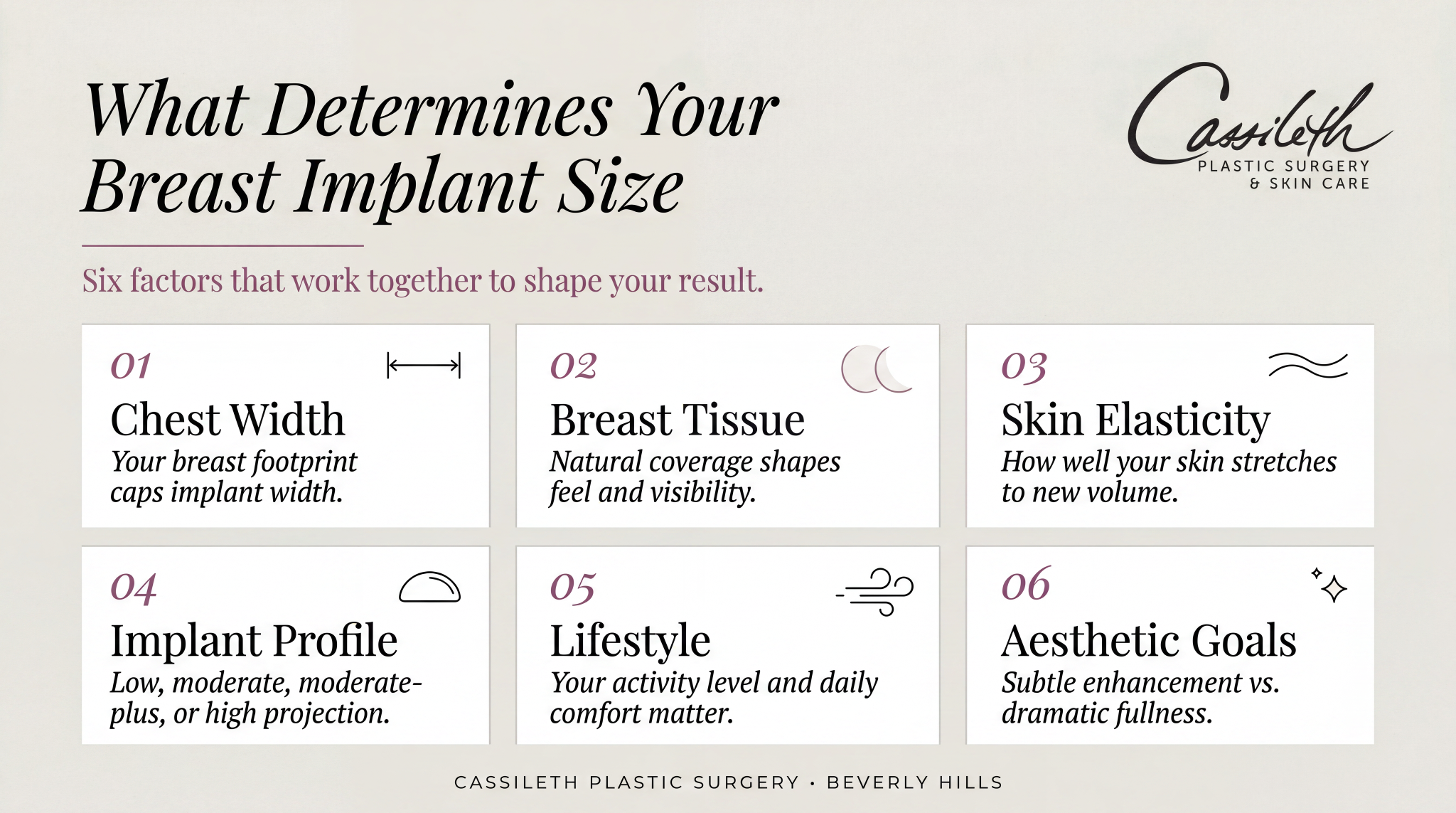
Several physical and lifestyle factors work together to define the best breast implant size for you. Your surgeon weighs these variables during consultation, fits them with your aesthetic goals, and narrows the options to a range your body can comfortably carry without compromise.
1. Chest Width and Body Frame
Your chest width sets the first hard limit. During consultation, your surgeon measures your breast footprint, the distance between the inner and outer edges of your natural tissue. That number caps how wide your implant can sit.
Stay within it, and your implant stays centered. Go beyond it, and you risk lateral drift or sternum crowding. Different frames support different breast implant sizes comfortably.
2. Existing Breast Tissue
The amount of natural tissue you have directly shapes your coverage. The more you have, the thicker the cushion above your implant, giving you a softer feel, fewer visible edges, and more flexibility in breast implant sizes.
If your tissue is minimal, however, rippling can show through at larger volumes, especially along the upper pole. Tissue quality also guides placement. Thin coverage usually calls for submuscular placement, while fuller tissue allows placement above the muscle for a more natural drape.
3. Skin Elasticity
Your skin has to stretch around new volume without permanently thinning or loosening.
Tighter, more elastic skin gives you more flexibility across breast implant sizes, while laxer skin can support larger volumes but may keep stretching over time.
Pregnancy, breastfeeding, and major weight changes all shift your elasticity. That’s worth weighing against how your breasts naturally change so your sizing reflects the body you have today, not the one you had five years ago.
4. Implant Profile
The breast implant profile describes how far your implant projects from your chest wall at a given volume. The four main profiles each deliver a different look:
- Low profile: the widest base with subtle forward projection
- Moderate profile: balanced width and projection for a natural look
- Moderate-plus: slightly more lift than moderate without going extreme
- High profile: prominent forward projection on a narrower base
That’s why two implants at the same cc can look completely different on your frame. Profile belongs in every sizing conversation.
5. Lifestyle and Activity Level
How you live matters just as much as how you look.
If you’re active, athletic, or physically demanding in your daily life, moderate breast augmentation sizes often suit you better. Very large implants can limit your shoulder range of motion, add perceived weight during running or lifting, and become uncomfortable over long workouts.
Your sizing conversation should factor in how you live, not just how you look in a fitted top.
6. Aesthetic Goals
What you actually want from your results shapes the final call. Some patients want subtle enhancement that flatters their existing shape, while others want a dramatic change that makes cleavage unmistakable in a V-neck.
Some prefer a natural slope with modest upper pole fullness, while others want rounded, fuller upper poles that sit prominently above the bra line.
So speak openly during your consultation. Share the look you want, the look you want to avoid, and the references that inspire you. That clarity helps your surgeon translate your vision into the right cc and profile combination.
Breast Implant Size Chart: CC to Cup Size Guide
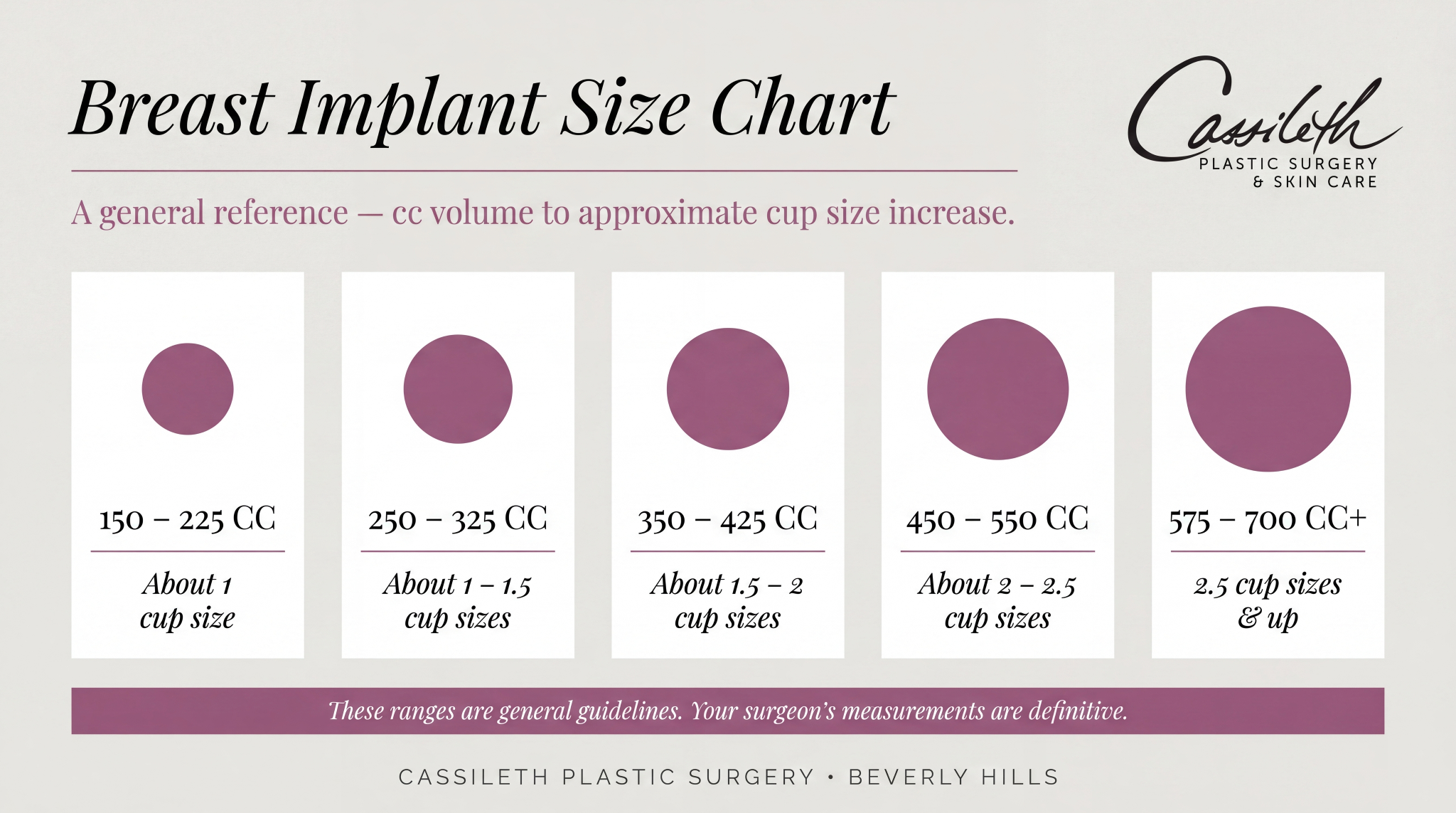
A breast implant size chart provides a rough estimate of the cup size change most patients can expect for a given cc volume. It helps you speak the same language as your surgeon and narrow your options before you ever try on sizers.
| CC Range | Approximate Cup Size Increase |
| 150cc – 225cc | About 1 cup size |
| 250cc – 325cc | About 1 to 1.5 cup sizes |
| 350cc – 425cc | About 1.5 to 2 cup sizes |
| 450cc – 550cc | About 2 to 2.5 cup sizes |
| 575cc – 700cc+ | About 2.5 cup sizes and up |
Every chart, however, comes with a meaningful disclaimer. Cup sizing varies wildly between bra brands and band sizes, and your starting anatomy, tissue quality, and frame all influence how any cc volume actually reads on you.
Two women with the same 400 cc implant can end up with different cup sizes depending on their preoperative tissue and chest measurements.
So treat the chart as a starting reference, not a guarantee. The numbers help you calibrate expectations, while physical sizers and 3D imaging translate those numbers into your real, post-operative appearance.
How to Visualize Your Breast Implant Size Before Surgery
Once you know your cc range, the next step is seeing it on your body.
Numbers on a chart stay abstract until you can picture them on your chest. Visualization tools close that gap, giving you a realistic preview of how your chosen breast implant sizes will look when you dress, move, and photograph yourself in the months after surgery.
The Rice Test
The rice test gives you a rough feel for volume before your consultation. You pour uncooked rice into a nylon stocking, tie it off, and slip it into an unpadded bra.
One cup is roughly 240 cc, so you can build and compare volumes clothing you already own.
That said, it only approximates volume. It can’t simulate implant profile, projection, or how your tissue will interact with the implant. Treat it as a conversation starter, not a final answer.
In-Office Sizing and 3D Imaging
In-office sizing takes you a step closer to reality. Your surgeon typically uses two tools to preview your result:
- Silicone sizers: slip into a fitted bra and mimic true implant volumes, letting you try different cc values and profiles under clothing.
- 3D imaging like Vectra captures a full scan of your chest and renders a realistic simulation of how specific breast implant sizes will look on you from every angle.
Still, the most accurate preview comes from an in-person assessment with your surgeon. Only a live measurement captures the nuances of your chest wall, skin, and tissue.
Silicone vs. Saline: Does Implant Type Affect Size Selection?
The implant material directly shapes how a given breast implant cc value feels and looks on you. According to the American Society of Plastic Surgeons, silicone is cohesive and soft, mimicking natural tissue, while saline implants are filled with salt water and feel firmer.
Logistics differ, too. Silicone arrives prefilled, while saline can be adjusted during surgery.
Newer Motiva implants also shift how a given cc presents on your chest. That’s why your type, size, and profile move together as one decision, not three separate ones.
| Feature | Silicone Gel Implants | Saline Implants |
| Fill material | Cohesive silicone gel | Sterile saline solution |
| Feel | Soft, closely mimics natural breast tissue | Firmer, more water-like consistency |
| Sizing | Prefilled in fixed cc increments | Filled within a specified range in the operating room |
| Volume adjustability | Chosen during planning | A modest adjustment possible during surgery |
| Rippling visibility | Less visible, especially in thin tissue | More likely to ripple at the sides in thin tissue |
| Coverage needs | Performs well across tissue types | Best suited to patients with more natural tissue |
| Rupture detection | Typically detected through imaging | Noticeable deflation of the breast |
| Best-fit candidate | Patients who want the most natural look and feel at a given breast implant size | Patients who prefer slightly firmer projection and a fill-range option |
What to Expect During Your Sizing Consultation

Your sizing consultation with Dr. Cassileth is structured so nothing feels rushed. It starts with careful measurements of your chest wall, base width, sternal notch-to-nipple distance, and tissue coverage. Those numbers anchor the conversation.
Next, Dr. Cassileth walks you through your goals in plain language. Share the look you want, the clothes you want to wear comfortably, the activities you want to return to, and any specific concerns.
Then you try sizers in a fitted bra and review 3D imaging when available, seeing multiple volumes and breast implant profiles side by side.
Dr. Cassileth also covers long-term considerations with you, including signs that your implants may need to be replaced in the future. You close with a recommendation tailored to your anatomy, goals, and lifestyle.
Emotional Confidence After Choosing the Right Size
Patients who actively participate in their sizing decision report meaningfully higher satisfaction after surgery. A 2025 analysis of 1,840 primary augmentations in the Aesthetic Surgery Journal found that when patients help select their implant volume, satisfaction rises significantly.
That confidence comes from proportional results that match what you pictured going in.
When your breast augmentation size reflects your anatomy and your goals, the mirror becomes reassuring rather than something you second-guess.
A short adjustment period is normal, however. Your eyes take a few weeks to register the new silhouette as yours, and that recalibration passes as the implants settle.
Why Choosing the Right Surgeon Matters for Implant Sizing
Your surgeon shapes your sizing decision more than any chart or sizer ever will.
A board-certified plastic surgeon balances what you want against what your tissue actually supports, because preferences alone won’t deliver a great result.
That’s why experience matters. Dr. Cassileth has shaped results across petite frames, athletic builds, and post-pregnancy bodies, spotting patterns you’d never catch on your own. At Cassileth Plastic Surgery, she combines chest wall measurements, tissue assessment, sizer fittings, and 3D simulation so the breast implant sizes you consider fit your body and your life.
What’s the Right Breast Implant Size for You?

The right size is always personal and always anatomy-driven. Charts and social media can spark ideas, but your measurements, tissue quality, lifestyle, and goals are what turn those ideas into results you actually love.
A consultation turns your thoughts into a real plan. You see your measurements, try on sizers, and preview your silhouette in 3D. Schedule your consultation with Dr. Cassileth in Beverly Hills to plan a size that fits your body and your life.
FAQs
What is the most common breast implant size?
Most patients choose between 275cc and 425cc, with 350cc sitting near the statistical center of primary augmentations. However, the most common breast implant size remains highly individual, as chest width, tissue quality, and aesthetic goals shape every decision you make.
How do I choose the right breast implant size?
Choosing the right breast implant size starts with chest measurements, tissue assessment, and an honest conversation about your lifestyle and goals. You then try sizers, review 3D imaging, and compare breast implant profiles with your surgeon to find the right fit.
Does breast implant size equal cup size?
No, breast implant size does not equal cup size. Breast implants are measured in cc volume, while cup size varies by bra brand and body proportions. An implant size chart offers a rough translation, but your final cup size depends on tissue and profile.
Can I change my breast implant size after surgery?
Yes, you can revise your breast implant size later through a secondary procedure. Some patients upsize or downsize as preferences shift. However, careful, measurement-driven breast augmentation size planning during your initial consultation reduces the likelihood that a revision will ever be necessary.
How do I choose a breast implant size that looks natural?
The most natural, best breast implant size fits your chest width, tissue quality, and body frame rather than a specific cc. Moderate profiles in the 250cc to 400cc range often read as the most natural across different breast implant sizes on average frames.

Lets Chat!
Contact Us
We believe that the connection between the patient and the provider is at the heart of every successful procedure and look forward to meeting you in person to discuss your goals.